The first eight weeks at Catrigg
Preparing Catrigg puppies for family life
A puppy cannot be fully prepared for everything it will experience in its new home by eight weeks old. But those first eight weeks can give it a valuable introduction.
From handling in the earliest days to new surfaces, household noises, outdoor spaces, car journeys and time on a lead, we gradually introduce each Catrigg litter to everyday experiences before collection day. The aim is not to send home a fully trained puppy. It is to make its new world a little less unfamiliar.
Your puppy’s first eight weeks at Catrigg
-
Birth and the earliest days
From day one
We are there from the beginning of each litter. As the puppies are born, details such as their sex and birth weight are recorded so we can keep track of each puppy from its first day.
Even before their eyes have opened, the puppies begin experiencing gentle human handling and different sensations. At this stage everything is deliberately simple. They remain with their mother and littermates while we monitor how they are developing.
-
Early development
Gentle handling and new sensations

During the early weeks, the puppies continue to be handled regularly as they begin becoming more aware of the world around them. we gradually vary the surfaces and sensations they experience rather than keeping their environment exactly the same every day.
These introductions are kept appropriate to the puppies’ age and development. The idea is not to overwhelm them. It is simply to make gentle change part of normal life from an early age.
-
Around three weeks onwards
More space to explore
As the puppies become more mobile, their world begins to get bigger. They are given access to larger areas where they can move around, explore and experience different surfaces underneath their feet.
This gives them opportunities to investigate their environment as their confidence and coordination develop.
-
As they begin weaning
Food, outdoor space and routine
The puppies are gradually weaned as they grow and become less dependent on their mother for food. They also begin spending time outdoors when appropriate.
We start encouraging the puppies to toilet away from the area where they eat and sleep, beginning the process of making outdoor toileting familiar before they move into their new homes.
-
As their world expands
Everyday sounds and activity
A quiet breeding environment might sound ideal, but family homes are rarely silent. As the puppies develop, we let them experience ordinary noises and activity around Catrigg. That can include sounds such as:
- Vacuum cleaners and wet vacs
- Televisions and radios
- Power washing and cleaning equipment
- People moving around and working nearby
The purpose is not to deliberately frighten puppies with loud noise. It is to allow normal everyday sounds to become part of their environment while they are still at Catrigg.
-
Before collection
New experiences before eight weeks
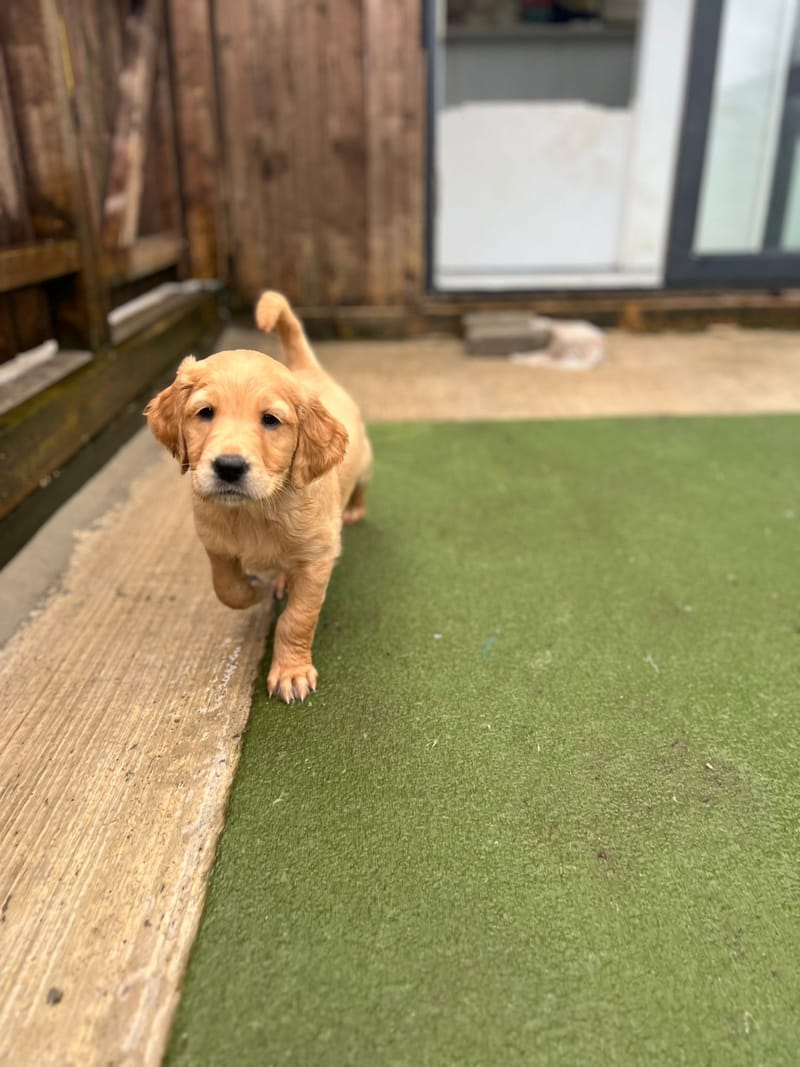
As collection approaches, we begin introducing the puppies to some of the experiences they will encounter once they leave. Depending on their age and development, this includes introductions to:
- Travelling in a car
- Wearing a collar
- Spending some time on a lead
- Outdoor toileting
- Different spaces and surfaces
- Other dogs in a controlled environment
- Everyday human contact and household activity
These are introductions, not promises that an eight-week-old puppy will arrive fully trained. The real training continues with you once your puppy comes home.
A more familiar world on collection day
Leaving Catrigg is a huge change for a young puppy. For the first eight weeks, their mother, littermates, our team and The Old Dairy are everything they know. Then suddenly, they are learning to socialise with new people, getting to know routines, boundaries and surroundings.
We cannot remove that change, and no responsible breeder can guarantee how an individual puppy will react to every new experience. What we can do is make sure that change itself is not completely new.
A good start does not replace training. It gives you somewhere to start from.

Every puppy is still an individual
Catrigg puppies leave with early experiences behind them, but they are still eight-week-old puppies. Their personalities differ, and moving home means learning new people, routines, boundaries and surroundings.
We do not claim that a puppy will arrive fully house-trained, lead-trained or comfortable with every situation it will ever encounter. Our role is to give each litter a thoughtful introduction. Your role as their new owner is to continue that work with patience, consistency and appropriate training as they grow.
What to have ready before collection day
You do not need to fill the house with puppy equipment before collection. A few basics will make those first days considerably easier and give your puppy somewhere safe to eat, sleep, play and settle. We will tell you what your puppy is being fed before collection so you can have the correct food ready at home.
Somewhere to sleep
- A suitable puppy bed
- A safe sleeping area
- A crate if you plan to use crate training
- Washable blankets or bedding
If you plan to use a crate, choose one suitable for your puppy as it grows and use an appropriate divider while they are small.
Food and water
- Food bowl
- Fresh water bowl
- Easy-to-clean mat underneath
- A supply of the food your puppy is already used to eating
We will tell you what your puppy is being fed before collection so you can have the correct food ready at home.
Collar, lead and travel
- Appropriately sized collar
- Lead
- Harness if you plan to use one
- A safe way of securing your puppy for the journey home
Your puppy may already have had a brief introduction to a collar, lead and car travel at Catrigg, but expect these to remain new skills that need gradual practice.
Toys and chewing
- Puppy-safe chew toys
- Soft toys
- Teething toys
- A few simple toys for interaction
You do not need dozens. A small selection of suitable toys is enough while you learn what your puppy actually enjoys.
Grooming
- Suitable grooming brush
- Puppy-safe shampoo when needed
- Towels for wet and muddy days
Introducing gentle grooming while your puppy is young can help brushing and handling become part of its normal routine.
Toileting and cleaning
- Cleaning products suitable for puppy accidents
- Easy access to the outdoor toileting area you plan to use
- Puppy pads if they form part of your chosen training approach
We begin encouraging outdoor toileting before collection, but accidents at home should still be expected.
Vet and insurance
- Choose and register with a local veterinary practice
- Decide how you will insure your puppy
- Keep a safe place for your puppy's paperwork and health information
We will confirm exactly what paperwork and health records come with your puppy before collection day.
Want to keep the list handy?
Download the puppy preparation checklist and tick things off as collection day gets closer.
Download the puppy checklist →
When collection day arrives
By collection day, your puppy will have spent its whole life so far with its mother and littermates at Catrigg. Going home with you is therefore a big change, even for a puppy that has already experienced car travel, handling and new environments.
Keep the first day simple. Give your puppy time to explore without introducing everyone and everything at once. Show them where they can sleep, where their water is and where you want them to toilet.
The goal for day one is not perfect behaviour. It is helping your puppy begin to feel safe in its new home.
The first few days at home
Expect an adjustment period. Your puppy has just left its mother, littermates and familiar surroundings, so the first night may be unsettled and there may be accidents while everyone learns the new routine. Try to keep things consistent:
Keep food familiar
Avoid suddenly changing your puppy’s diet on the same day everything else changes.
Keep the routine simple
Food, sleep, play, toileting and quiet time do not need to become complicated.
Give them somewhere to switch off
Young puppies need a lot of sleep. Give your puppy somewhere calm where they can settle without constant attention.
Continue the introductions gradually
New people, places, dogs, journeys and experiences should continue over time rather than all arriving during the first weekend.
Be patient with training
Toileting, walking on a lead, recall and settling alone are skills that develop through repetition. Your puppy has had an introduction at Catrigg. You now continue the process.
We are still at the end of the phone
Collection day is not the end of your contact with Catrigg. If something is worrying you or you have a question as your puppy settles in, get in touch. You have taken the puppy home, but you do not have to suddenly work everything out alone.
Looking for a family retriever?
Start with a puppy enquiry
If the way we raise and prepare our puppies sounds like what you’re looking for, send us a few details about yourself and the puppy you hope to bring home. A member of our team will give you a call to discuss upcoming litters, the waiting list and any questions you have.